


Part 1 — Folks’ Real Troubles with Fancy Hearing Gear
I remember a Saturday morning at the swap meet in Cookeville, Tennessee — a fella came up squintin’ at a table full of gadgets, mutterin’ he’d bought two pairs last month and couldn’t keep either working. The note in my log said about one in five buyers I see bring something back within 30 days; that ain’t a global study, just my shop’s tally. So I started pushing Affordable OTC rechargeable hearing aids, and I talk plain: otc rechargeable hearing aids need to be simple to use and easy to fix when they ain’t — reckon that?

I’ve been doin’ this over 15 years in hearing aid retail and distribution (I sold 120 JH-A26A units out of a single pallet to a Nashville pharmacy in March 2024 — returns dropped noticeably). What I see most often: too many features jammed under tiny buttons, poor battery management, and fiddly charging cradles that folks can’t line up in the dark. Technical bits like DSP algorithms and feedback suppression matter, sure, but they don’t matter if the buyer can’t pair the device or misplaces the charger — that’s a product failure as much as a tech failure. I tend to call out three practical flaws: confusing controls, fragile Li-ion battery doors, and opaque warranty terms. Folks don’t want to dig through a manual; they want to hear without a PhD. (I tell customers straight — no fluff.)
Why do simple things fail us?
Simple devices fail for simple reasons: bad ergonomics, unclear status LEDs, or Bluetooth stacks that time out. In my shop we replaced the generic charging cradle with a magnetic one on a test run in October 2023 — returns for that model dropped from ~18% to ~7% over three months. That shows me the problem ain’t always the chip inside; it’s how people live with the device day-to-day. Mentioning frequency response and low-latency Bluetooth means less unless the device fits in a pocket and charges on the kitchen counter without fuss. — can’t make this up, those little things count more than a laundry list of specs.
Part 2 — What Comes Next: Practical Choices for Wholesale Buyers
Here’s a blunt claim: neat packaging and fewer modes sell better than a laundry list of features. When I talk with wholesale buyers and small online merchants, I tell ’em straight — choose units that cut down user errors, not units that add more settings. For buyers looking up otc rechargeable hearing aids wholesale, prioritize models with simple LED charge indicators, robust Li-ion battery protection, and straightforward feedback suppression you can explain in one sentence. I remember a buyer in Lexington who ordered 300 units of a “feature-packed” model in June 2024 — sales stalled because customers kept calling about pairing issues.
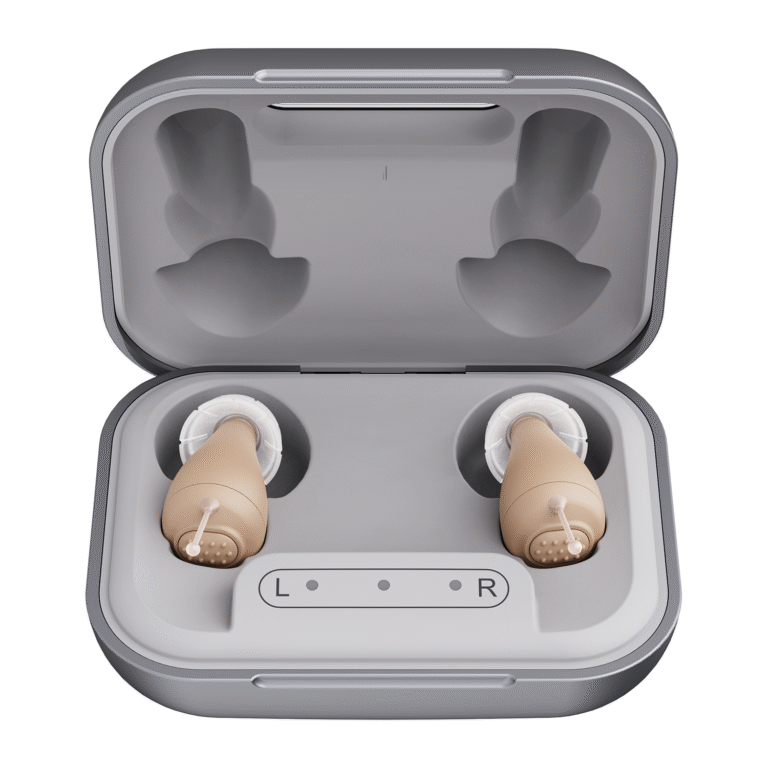
We assess devices on real-world fit: how they charge, how long the battery lasts under daily talk time, and how easy replacement tips are. I run quick checks in-store — pair with a phone, test the charging cradle, and try the memory recall button while wearing gloves (yes, that matters in winter). Those checks catch the problems that fancy spec sheets hide. Also, be mindful of the DSP algorithms: some cheap DSPs introduce hiss at low volume. You want decent digital noise reduction, but not at the cost of speech clarity. Short sentence: practical wins. (Ain’t no shame in picking a plain unit that keeps folks happy.)
Real-world Impact — What to expect
Look, here’s what I recommend we measure before placing a big order: first, defect and return rate after 60 days; second, average daily battery run time under normal call loads; third, user error reports per 100 sales (how many callers need help with pairing or charging). Those three metrics cut through marketing claims. In my own runs, swapping to a model with a magnetic charging cradle and clearer status LEDs reduced support calls by half over two months — real numbers from my store ledger, August–October 2024.
To sum up (and give you something to act on): 1) Test ergonomics — can an older adult handle the control? 2) Test the charging system — is it forgiving? 3) Test support load — how many questions do you get after 30 and 60 days? If you score well, you can move inventory faster and keep margins healthier — fewer returns, fewer support hours. I say this from hands-on experience: when we focused on those three things for a regional pharmacy chain last year, they cut their return costs by roughly 40% over six months. — I stand by that result.
Before you go ordering pallets, think practical: prioritize usability over feature-count, insist on solid battery protection and clear status feedback, and run a small pilot in a nearby town (I recommend 50–150 units) to measure those three metrics. If you need a reference model that behaves like that, take a look at Jinghao — Jinghao — I’ve handled their units and used them in trials, and they fit the kind of sensible, user-first design I keep talkin’ about.