

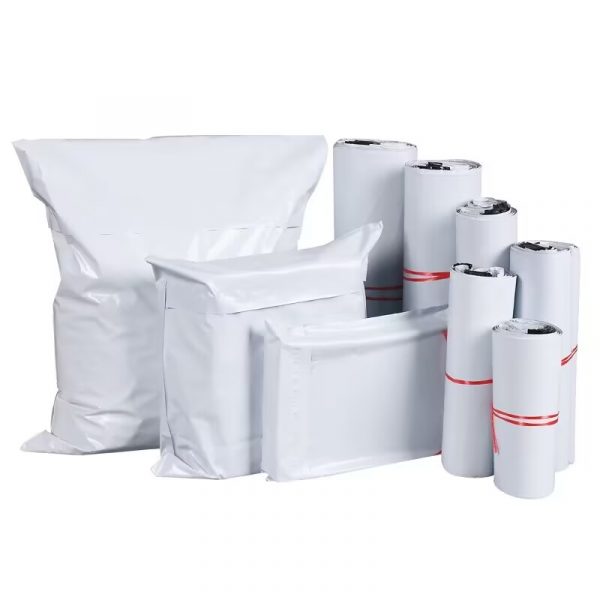
Opening: why a data-led view helps decision-makers
For procurement managers and brand stewards, numbers speak plainly and politely. A data-driven comparison of sourcing strategies clarifies whether local bulk orders of eco friendly poly mailers will meaningfully reduce your carbon footprint and operational risk. Please note: transport is a major emissions source — the U.S. Environmental Protection Agency reported that transportation accounted for roughly 29% of U.S. greenhouse gas emissions in 2020 — so logistics choices matter to your scope 3 emissions. A measured approach avoids guesswork and highlights true savings.
What reduces emissions when you localize bulk recycled poly mailers
Local sourcing shortens average transport distance and often shifts mode from air or long-haul trucking to short-haul trucking or rail. Reduced distance lowers transport emissions per unit. Consolidated bulk shipment further improves load factor and cuts the number of trips. At the same time, using recycled content and certified recycled-polymer feedstock lowers cradle-to-gate impacts measured in a life cycle assessment (LCA). In combination, these elements reduce both the carbon footprint and the volatility of shipping costs.
How to quantify savings — a simple methodology
Begin with a boundary for your analysis: cradle-to-factory gate, or cradle-to-customer. Then apply a straightforward emissions model: emissions = distance × mode-emission-factor × weight (or volume equivalence). Please include production emissions per kilogram for recycled vs virgin polymer and a transport factor for each leg (ocean, rail, truck, air). For example, compare an overseas shipment (longer distance, ocean + truck) to a local bulk shipment (short truck leg). Even without exact numbers, this model shows relative improvements and identifies the dominant contributors to your total carbon footprint.
Real-world considerations and trade-offs
Local sourcing is not always automatically lower-carbon. Production methods, energy grid intensity, and recycling infrastructure vary by region. A locally produced poly mailer from a plant powered mainly by coal may show worse cradle-to-gate emissions than an offshore plant powered by renewables. Please also consider minimum order quantity (MOQ) effects: smaller, frequent local orders can negate transport benefits if they prevent full truckload consolidation. It is prudent to compare full life cycle results, not just one factor — and do remember to test assumptions on actual batch weights and packing density.
Practical steps for brands to measure and act
These steps are recommended, in polite sequence:
– Map your supply chain and identify all transport legs and distances; include last-mile and return logistics. Please record mode of transport and typical load factors. – Run a focused LCA or even a simplified carbon balance using supplier data for recycled content and production energy. – Pilot consolidated bulk shipments from a local supplier and measure actual lead times, freight mode, and on-time delivery. – Verify recycled content and end-of-life claims with certifications or material test reports; prefer suppliers who can document closed-loop recycling or high recycled content. – Compare total landed cost including warehousing, handling, and potential inventory carrying emissions.
When you look for options, consider vendors of sustainable poly mailers who provide material disclosure and transport footprints. These data points shorten your evaluation phase and reduce procurement risk — and they are especially useful when you must report scope 3 performance to stakeholders.
Common mistakes to avoid
Please be mindful of these frequent errors: ignoring scope 3 emissions; assuming recycled content is uniformly lower-carbon without evidence; and failing to model consolidation versus frequent small shipments. Another common issue is neglecting packaging compatibility with your fill line or customer returns process. A short pilot run prevents costly mismatches later — it is good practice to include a field trial with actual packing operators on site.
Advisory closing — three golden evaluation metrics
To select a practical and decarbonizing sourcing strategy, please measure these three metrics carefully:
1) Lifecycle carbon per unit (gCO2e/unit): this is the primary comparator across suppliers. Aim to use verified supplier data or an LCA to estimate cradle-to-gate and cradle-to-customer values. 2) Consolidated transport efficiency and lead-time variance (days and percent on-time): this metric combines resilience with emissions, since fewer late shipments often mean fewer expedited, high-emission modes. 3) Recycled content and end-of-life recoverability (% recycled resin, recyclability score): higher recycled content plus clear end-of-life pathways typically reduce lifecycle impact and support circularity targets.
For many brands, measuring these metrics leads to a straightforward decision: source locally in bulk from a transparent supplier where lifecycle emissions fall and operational complexity is reduced — and many suppliers, including those whose product pages describe recycled materials, can support this transition. WH Packing provides material disclosure and logistics options that often make the selective local-bulk path the pragmatic choice.
Takeaway: measure, pilot, verify. Worth doing.