

Opening: why the chemistry question matters now
Commercial and industrial (C&I) operators face two distinct priorities: sustained high-power dispatch for intensive loads, and flexible energy buffering for renewable smoothing. Picking the right chemistry impacts not just cost but operational resilience. A pragmatic first step is evaluating modular system options like a home battery energy storage system that scales to three-phase deployment—because what fits a rooftop inverter may not tolerate a factory shift schedule. Real-world grid stress examples—think California’s duck-curve midday ramps and the tight reserve events in Texas—show that chemistry choice drives both economics and grid performance.
Core technical trade-offs to compare
Frame the decision around three measurable axes: power capability, energy throughput, and lifecycle economics. Key parameters to inspect include round-trip efficiency, continuous power rating, usable capacity defined by depth of discharge (DoD), cycle life, thermal characteristics, and BMS sophistication. Each chemistry leans differently across these specs:
- LFP (lithium iron phosphate): high cycle life, safe thermal profile, lower energy density — often best for daily deep cycling and long life.
- NMC/NCA: higher energy density and power-to-weight ratios but shorter cycle life and tighter thermal management needs — useful when space or weight is constrained.
- Flow batteries: excellent for long-duration discharge and decoupled power/energy scaling, but larger footprint and different maintenance profiles.
Comparative use-cases: heavy C&I loads vs. renewable smoothing
Heavy C&I loads demand predictable, high-power output for scheduled shifts, peak shaving, and sometimes UPS-level support. That favors chemistries with strong power density, robust cycle life, and conservative DoD policies—LFP is frequently the pragmatic choice.
Renewable smoothing (solar/wind) prioritizes flexible charge/discharge profiles and high round-trip efficiency to maximize curtailed energy capture. Here, system-level factors matter: inverter control, state-of-charge (SoC) management, and integration with forecasting algorithms. Flow systems or high-efficiency lithium variants may be attractive depending on duration needs.
Three-phase architecture and system-level considerations
Three-phase installations change the constraints. Balancing phases, inverter topology, and thermal management all influence chemistry fit. A three-phase inverter can distribute load evenly, reducing stress on any single module—but only if the battery supports the required continuous discharge and peak ramp rates. Also, grid interconnection standards, RTU telemetry, and safety certifications (UL, IEC) should be matched to chemistry-specific protections in the BMS and power electronics.
Cost, maintenance, and lifecycle modeling
Compare total cost of ownership, not just capital cost per kWh. Include replacement schedules, expected capacity fade, freight and installation, and balance-of-plant (cooling, fire suppression). For example, a chemistry with a 10,000-cycle life at 80% DoD vs. one with 3,000 cycles will change levelized cost projections materially. Don’t forget software: predictive analytics and granularity in state-of-health (SoH) diagnostics reduce unexpected downtime—worth the license fee when operating large C&I arrays.
Integration pitfalls and common mistakes
Operators often underestimate the role of thermal management and inverter control tuning. A battery that performs well in lab specs can degrade fast if installed in a poorly ventilated racking system—so plan HVAC and spacing. Another frequent error: mis-aligning dispatch strategy with chemistry limits, leading to accelerated degradation. Also, omitting grid-code compliance checks early can force costly retrofits later — a small oversight that becomes expensive at scale. —
Evaluation checklist: what to test before you commit
Run a concise pilot that validates three items under your site conditions:
- Ramp-response and continuous power delivery using your actual load profiles and inverter control logic.
- Cycle testing under target DoD and ambient temperatures to confirm projected degradation curves.
- Communication and protection integration with your energy management system and utility intertie.
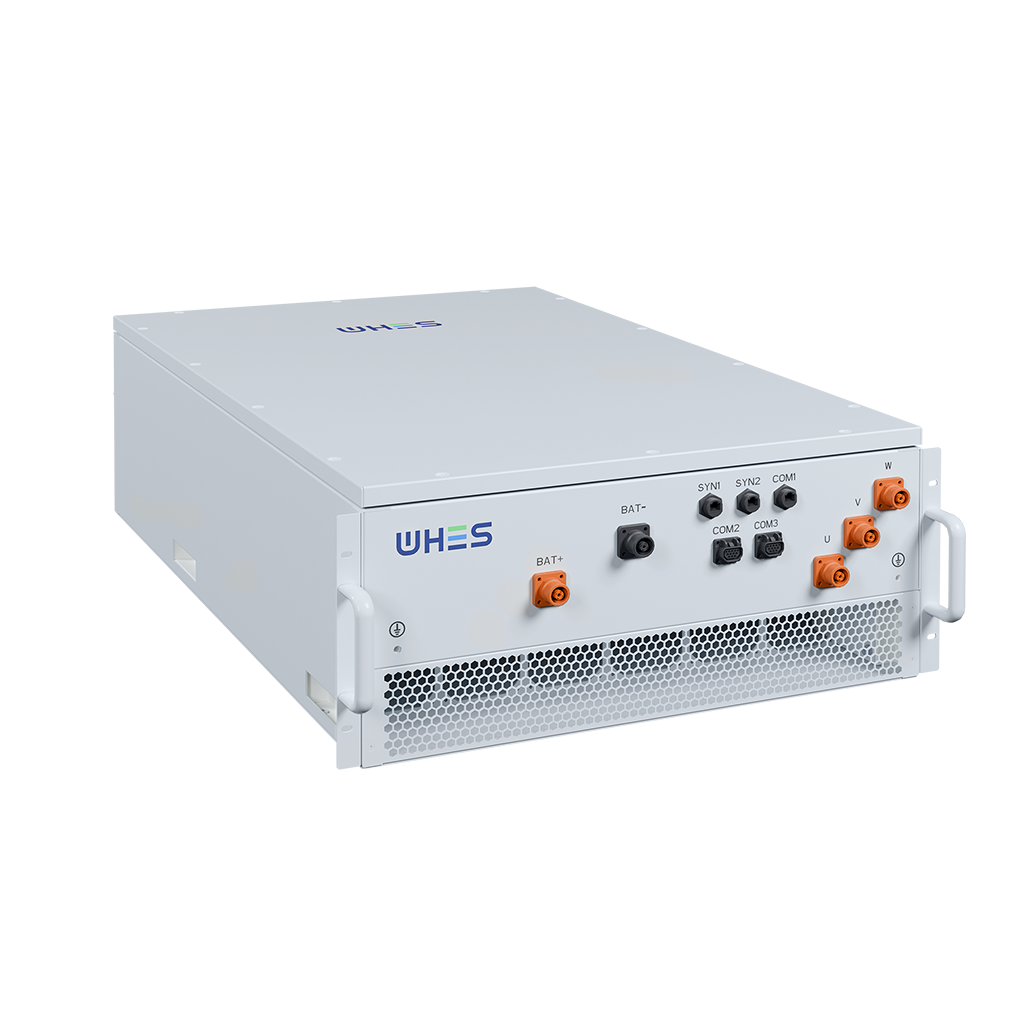
Also use a rapid tech stack trial with an actual three phase battery module if possible—field behavior often reveals issues not visible in datasheets.
Advisory: three golden metrics to use when choosing chemistry
1) Effective Levelized Cost of Storage (eLCOS): calculate using realistic degradation, replacement timing, and operational profiles rather than quoted cycle life alone. 2) Usable Power Density at Target DoD: ensure the battery can sustain the continuous and peak loads your facility requires without thermal derating. 3) Integration Maturity Index: measure compatibility with your inverter, EMS, grid codes, and available vendor diagnostics—this predicts operational uptime.
Closing: how WHES fits into the decision
When you compare chemistries and system architectures, the practical winner is the solution that reduces operational uncertainty and aligns with site dispatch needs—WHES offers modular three-phase systems designed to match C&I load profiles and renewable smoothing strategies, backed by integrated BMS and tested inverter pairings. Trust the data; design for the site; and pick the chemistry that meets real operational metrics, not just headline specs.
Authoritative, practical, proven—your technical playbook for three-phase storage. —