

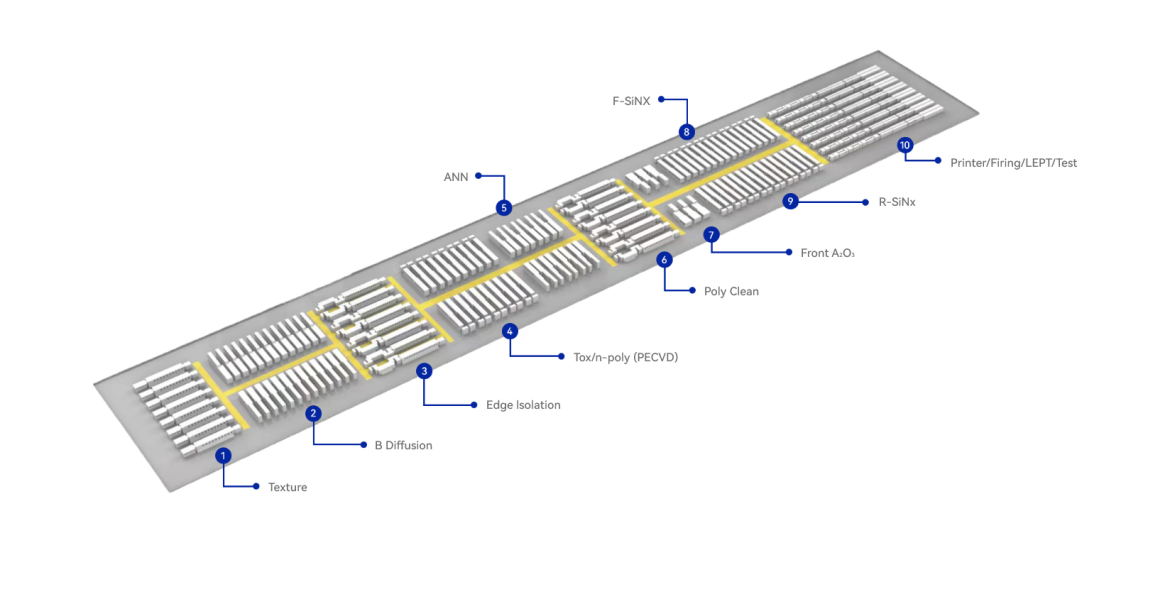
A Technical Lens on the Real Factory Trade-offs
Define the goal first: raise yield and watts without breaking cycle time. In the second step, align every station to the physics of the topcon solar cell. In pv cell manufacturing, that means a system change, not a tool swap (yes, the difference matters). Picture a plant manager staring at a heat map of bottlenecks before peak season. Efficiency promises look high—24%+—yet scrap and rework creep in. Data says OEE drops when diffusion and passivation drift by even small margins. So, what really shifts when you go beyond PERC and step into n-type, passivated-contact territory?

This is where urgency meets detail. The passivated contact stack, the tighter thermal window, and the new metrology cadence all push the line in new ways. If you miss alignment between furnace profiles and PECVD stacks, downstream metallization will tell on you. Fast. And the I-V curve will show the penalty. The question is simple: can your flow absorb these sensitivities without adding cost per watt? Let’s move from promise to practice—next, we unpack the blind spots that slow teams down.
Where Traditional Fixes Crack Under TOPCon
Why do old fixes fail?
Legacy playbooks say “buffer more WIP” or “add a second diffusion furnace.” That used to mask drift. With TOPCon, the flaws surface sooner. Passivated contact layers need tight control of sheet resistance and interface quality; quick patches only move the error. Look, it’s simpler than you think: if PECVD uniformity varies, your bifacial gain won’t be stable, and the I-V curve spreads. Operators chase variance with longer test cycles, then throughput falls. Meanwhile, LID looks different on n-type wafers; treating it like p-type PERC risk just wastes time. The line gets noisier, and dashboards light up, but root cause stays hidden.
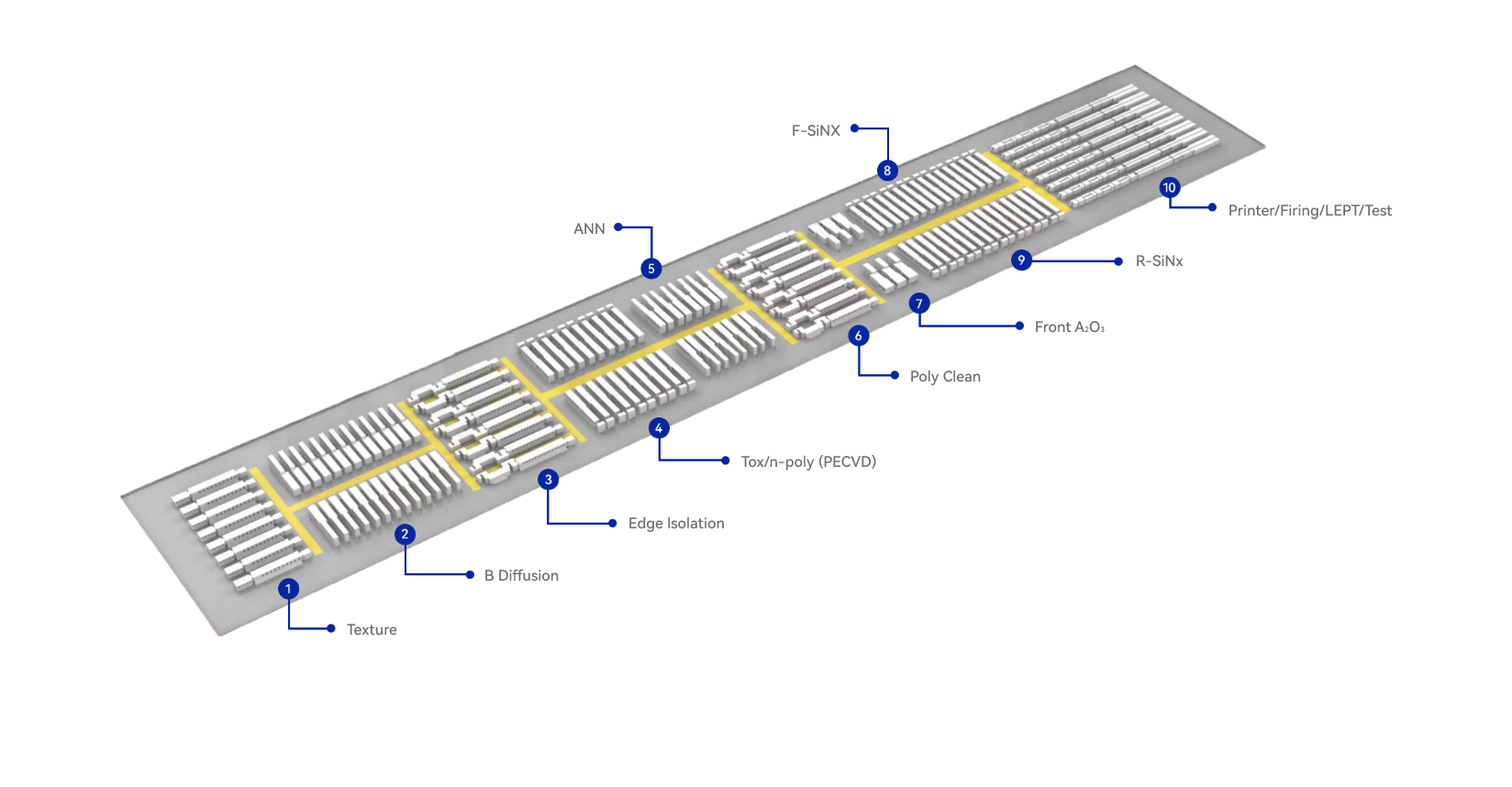
Consider metrology. Traditional sampling rates catch gross faults, not micro-drifts in contact recombination. You need in-line checks that tie directly to passivation stack health, not just end-of-line sort bins. Otherwise, metallization becomes the scapegoat whenever fill factor softens. And energy pulls spike as power converters throttle to cover unstable process timing—funny how that works, right? The net effect: higher cost per watt, plus slower ramps, even though the cell physics allows more. The fix is not more alarms. It is redesigning the control loop so diffusion, PECVD, and screen print share one playbook, not three.
Comparative Principles for the Next Wave
What’s Next
Future-ready lines treat TOPCon as a coordinated system, not a stack of tools. Here’s the principle: close the loop between front-end deposition, thermal budgets, and back-end current collection—continuously. In practice, that means tighter digital twins and smarter in-line sampling, so drift is corrected at source, not at the tester. In modern pv cell manufacturing, the winning pattern compares real-time sheet resistance to modeled passivation loss, and adjusts recipes before wafers hit metallization. Semi-formal, but very direct. Then, connect to power converters data at the inverter side to see how cell variance maps to field output. Small recipe shifts. Big stability—funny how that works, right?
We saw the pitfalls: old buffers hide causes, and random sampling misses the drift. Now, compare two paths. One adds more testers and operators. The other builds process-aware control, using fewer checks but smarter triggers. The second wins on OEE and time-to-ramp because it aligns physics with flow. Advisory close: choose solutions with three metrics in mind—first, watts per tool-hour at stable yield (not peak-hour snapshots). Second, variance of open-circuit voltage across lots over a week, tied to recipe revisions. Third, line energy per MW produced, normalized by rework rate. If those scores improve together, you’re moving right. If not, revisit the loop—and keep it simple with one source of truth from diffusion to test to field. Brand note: guidance like this travels best with partners who build around these controls, such as LEAD.