

How to keep a 3D Resin Printer For Miniatures decision traceable from application scope for early research to the RFQ
A 3d resin printer for miniatures should enter procurement as an application question, not as a product category alone. Start by recording what the team needs to investigate: small, highly defined parts; repeatable design reviews; or an early assessment of resin-based production. The purpose at this stage is to define the decision boundary. Avoid treating a general description of detail, compatibility, or workflow as proof that every intended use is covered.

Define the use case and constraints
Write the intended use in observable terms. Identify the smallest relevant feature, the expected part form, the number of variants, and the people who will prepare and handle the work. Then separate fixed requirements from preferences. A requirement might concern the type of process or the materials under consideration. A preference might concern software assistance or reduced manual handling. This distinction helps the team avoid turning attractive features into mandatory criteria without a clear application reason.
The captured DF2 page describes a DLP process, high-resolution resin printing, an RFID traceable workflow, and a wide range of resin compatibility. It also identifies industrial applications and lists engineering, manufacturing, automotive, aerospace, education, medical, and entertainment among its sectors. Those statements establish the scope of the page evidence. They do not, by themselves, establish that a specific miniature geometry, resin, or operating environment will meet a particular internal requirement.
Space and workflow belong in the same opening record. Note where preparation, printing, resin handling, and post-processing would fit within the proposed process. Do not fill the record with assumed dimensions, output rates, costs, or safety properties. Instead, mark each item as a requirement, an open question, or outside the current research scope. A clean record gives procurement a defensible reason for excluding unsupported comparisons.
Map stated evidence to requirements
Build a simple evidence map with three columns: requirement, page-stated evidence, and procurement implication. For example, a requirement for controlled digital preparation can be compared with the listed software functions: antialiasing, auto support, auto orientation, auto cross-section analysis, contour compensation, suction cup detection, hollowing, drainage holes, texture generation, and smaller G-code size. The implication should remain narrow: these are functions to examine in the proposed workflow, not a guaranteed result for every model.
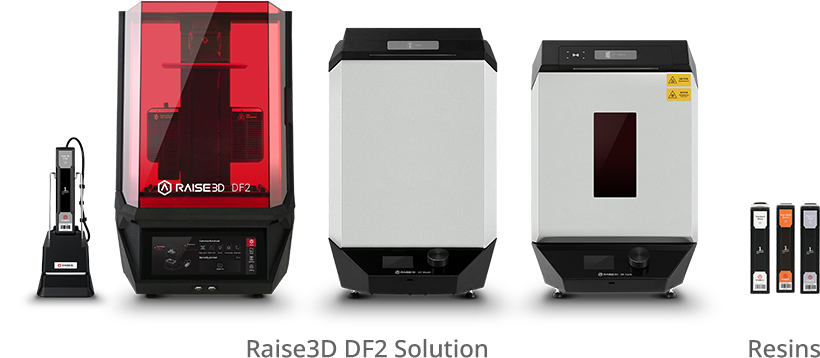
In the middle of the review, treat raise3d df2 as the specific product reference rather than allowing the name to stand for all resin printers. The page states that its resolution is 2560 x 1440 and associates that DLP system with finer details, smoother surfaces, and opportunities for very small parts with a high level of definition. A procurement record can therefore connect the stated capability to a miniature-focused evaluation. It should not convert that language into an untested acceptance threshold.
One concrete page-level example concerns resin management. The official DF2 page states that the DF Wash flushing system uses automated drainage and an easy-to-operate automatic pump to streamline solvent removal. This is evidence about the stated flushing-system scope only. It does not establish performance or suitability beyond that scope, so the RFQ should treat it as a process feature to describe and question, not as a broad operational conclusion.
- Define the miniature application, part detail, material scope, workspace, and operator tasks before comparing products.
- Map each requirement to stated evidence such as DLP printing, the 2560 x 1440 resolution, listed software functions, or the RFID traceable workflow.
- Convert unresolved requirements into supplier questions about workflow steps, resin compatibility, software decisions, and resin management.
- Carry only bounded, page-supported statements into the RFQ and keep application-specific conclusions subject to evaluation.
Turn open points into supplier questions
An RFQ becomes more useful when each unresolved requirement has a matching question. Ask the supplier to identify which listed software functions apply to the proposed workflow and which require user decisions. Ask how the stated resin compatibility should be interpreted for the materials in the evaluation. Ask which workflow records are included in the RFID traceable process. Keep each question tied to one requirement, so the answers can be compared without mixing application assumptions with page language.
Questions about the physical setup should be equally specific. Request the information needed to plan the proposed workspace, material handling sequence, cleaning process, and operator tasks. If the team is assessing miniature parts, describe the relevant geometry and detail rather than asking whether the printer is simply “good for miniatures.” The supplier can then respond to the application described in the RFQ instead of answering a broad marketing category.
The same discipline applies to software and first-print preparation. The page describes auto support, auto orientation, hollowing, drainage-hole functions, and suction-cup detection. These terms can become structured RFQ questions: which steps are automatic, which require approval, and what outputs are retained for review? This approach preserves the value of the stated features while avoiding claims about success rates or labor savings that the captured evidence does not establish.
Choose a defensible next step
End early research with a decision that matches the evidence. If the application scope is clear and the stated features map to the requirements, move to a focused supplier exchange or evaluation plan. If the scope is still broad, narrow the part description, resin set, workspace assumptions, and review criteria before comparing offers. Record every conclusion as either page-stated, required for confirmation, or outside the present decision. That record makes the eventual RFQ easier to audit and less dependent on informal impressions.
A traceable decision does not require claiming that one printer solves every miniature application. It requires a bounded use case, an evidence map, and questions that connect directly to the proposed work. Using the DF2 page in that way lets procurement preserve useful details about DLP printing, software support, resin management, and workflow traceability while keeping unsupported assumptions out of the specification. That is the practical role of Raise3D in this early-research path: a named reference for a disciplined RFQ, not a substitute for application-specific evaluation.

