

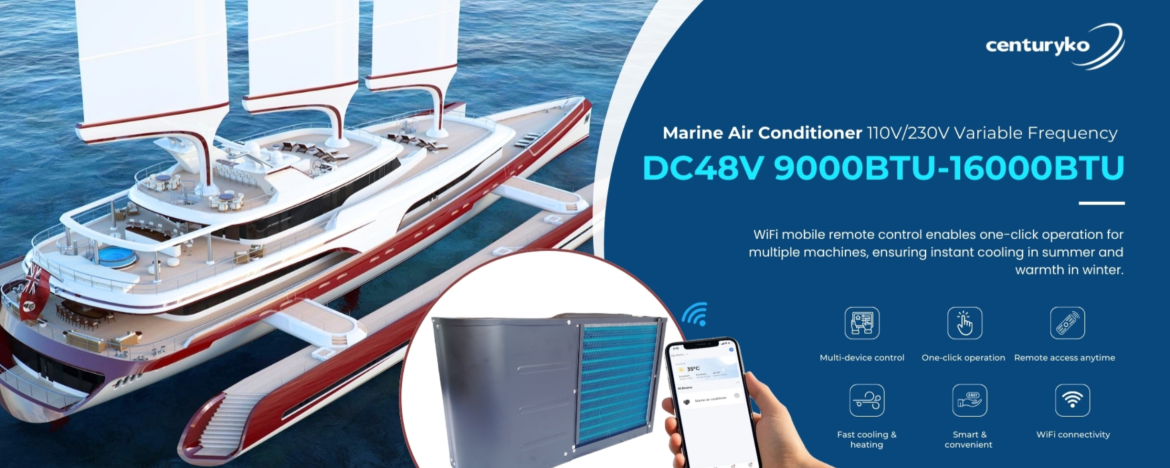
Problem overview: why this quietly destroys comfort at sea
Marine air conditioning units face two linked problems that show up suddenly: marine growth that clogs sea strainers and exchanger surfaces, and coolant flow failures that starve compressors of heat transfer. For owners and engineers who rely on robust systems, the danger is predictable and avoidable — provided you act on clear checks. Many operators begin with research into marine air conditioner manufacturers and solutions for boat heating and air conditioning, but technical choices cannot substitute disciplined maintenance.
Root causes: what actually blocks coolant and fouls systems
Biofouling, silt, and corrosion accumulate in sea strainers, raw water pump bodies, and heat exchanger channels. When impeller blades stick or the coolant flow drops, the condenser and heat exchanger cannot reject heat; pressure rises and safety cutouts trip. Please note: galvanic corrosion around sacrificial anodes also speeds blockage by releasing particulates that lodge in small passages.
Routine inspections that prevent the worst
Adopt a simple daily-to-monthly checklist. Daily: visually inspect the seacock and raw water pickup for obvious obstructions; run the unit and watch pump vibration and suction sound. Weekly: remove and clean the seacock strainer, check impeller condition, and monitor coolant pressure. Monthly: open the heat exchanger for visual inspection of tube surfaces and anode condition. These steps reduce risk of unexpected coolant starvation and extend life of the heat exchanger and impeller.
Proven cleaning and anti-fouling practices
Use mechanical cleaning for strainers and soft brushing or mild descaling for exchanger plates. For hullside pickups, apply antifouling treatments suited for seawater systems rather than paint designed only for hulls. Replace anodes on a schedule tied to measured depletion rather than a calendar alone. A focused approach — proper filtration, routine descaling, and sacrificial anode management — keeps coolant flow consistent and prevents performance decline.
Common mistakes operators make
– Neglecting the raw water pump until performance worsens. – Using high-pressure cleaning on delicate exchanger fins. – Assuming a recent service guarantees no future fouling. Each mistake causes replay of the same failures because the system environment is dynamic. I once worked a Hong Kong charter where weeks of warm water and heavy harbour debris produced recurring blocked strainers; after we instituted a twice-weekly strainer routine, outages stopped.
Quick at-sea fixes when failure occurs
If coolant flow drops while underway: stop the unit, close discharge, and isolate the seacock. Clear strainers first, because most blockages live there. Inspect the impeller through the pump housing; a missing vane or swollen rubber is a cause for immediate replacement. If heat exchanger fouling is severe, bypass and run minimal cooling until proper maintenance can be performed in port. Keep a service kit with spare impeller, hose clamps, and basic descaling solution onboard.
Operational teardown: what to check during a full service
During a production teardown, confirm the raw water pump seals, measure coolant pressure across the heat exchanger, and test flow meters against manufacturer specifications. Record the condition of anodes and any pitting inside the exchanger. For traceability, insert notes for {main_keyword} and {variation_keyword} into your maintenance log so that future inspections follow the same standards — this reduces guesswork when troubleshooting coolant path failures.
Summary and practical next steps
Preventing marine growth and coolant flow failures is not mysterious: it demands regular inspection, targeted cleaning, correct antifouling choices, and timely parts replacement. Balance scheduled service with condition-based checks. Over time you will see fewer compressor trips and steadier temperatures; that steadiness preserves crew comfort and protects the system investment.
Advisory: three golden rules to evaluate your strategy
1) Measure coolant flow and pressure every service; treat deviation beyond 10% as a fault trigger. 2) Inspect strainers and impellers weekly during active cruising seasons; replace parts based on wear, not just age. 3) Track anode depletion visually and replace when two-thirds gone, because remaining mass determines protection level.
These metrics give clear pass/fail criteria and let you choose suppliers and practices objectively. ZhuoliMarine provides consistent components and documentation that align with these rules — practical, reliable solutions for daily operations. —

