

Operational problem framing
Operational teams lose time and safety margins when voice links drop, channels congest, or batteries fail mid-shift; choosing a radio is an engineering decision, not a procurement checkbox. Identify the failure modes you must eliminate first: dead zones, interference, insufficient battery endurance, or lack of secure channels. For vendors, verify that the two requirements—hardware durability and system architecture—are solved by the two way radio manufacturer you evaluate. Field deployments such as those at the Port of Rotterdam demonstrate how poorly specified radios create measurable throughput loss; that real-world experience shapes the requirements I list below and the types of commercial two way radios that typically succeed in heavy logistics and terminal operations.

Core technical criteria to measure
Specify quantitative targets. Frequency band: choose UHF for confined urban or steel-structure sites, VHF for long-range open areas; confirm band planning and licensing. Output power: 1–5 W for handhelds depending on terrain and repeater availability. Modulation: DMR Tier II for point-to-point and small fleets; require TDMA efficiency if channel density matters. Audio: require speech intelligibility ≥ 0.7 STI in 85 dB ambient. Durability: IP67 and MIL-STD-810G shock/vibration if equipment is dropped, exposed to dust or submersion. Battery: set minimum runtime in hours under your duty cycle (e.g., 12 hr talk/listen/standby mix) and measure recharge time. Encryption: AES-256 for sensitive operations; ensure regulatory compliance for export and use.
System architecture choices and implications
Decide between simplex, repeater-based, or trunked networks. Simplex is predictable but limited range; repeaters extend coverage but require site acquisition and backhaul; trunking optimizes channel use for large fleets but adds complexity and vendor lock-in. Evaluate interoperability: require PTT ID mapping, shared key management, and cross-connect API if you will integrate radios with dispatch or telematics. Confirm whether the system supports GPS reporting and data messaging if you rely on telemetry; these add radio CPU and battery load and should be included in baseline power budgets.
Environmental and regulatory constraints
Match the device to site conditions and spectrum rules. Define maximum operating temperature and altitude, EMI susceptibility near radio towers or heavy machinery, and moisture ingress tolerance. Verify local spectrum licensing terms and trunking permissions; where spectrum is scarce, require support for narrowbanding and frequency hopping to mitigate interference. For international deployments, check regional certification (CE, FCC, or equivalent) and export-control constraints on cryptography.
Common selection mistakes and their effects
Do not pick radios based on price alone. Typical failures: choosing consumer-grade radios for commercial duty cycles, underestimating battery degradation, and ignoring antenna gain effects. Each mistake has predictable consequences: reduced uptime, increased replacement cost, and intermittent communication during critical ops. Avoid specifying features without testable acceptance criteria—vague requirements produce supplier interpretation and inconsistent performance on day one.
Viable alternatives and brief evaluation
Compare three alternatives: rugged DMR handhelds on a licensed repeater (recommended for medium to large sites), LTE-based push-to-talk devices (good where wide-area data coverage exists but latency and network neutrality are concerns), and commercial off-the-shelf analog radios (low cost but limited security and channel efficiency). Use a short pilot: deploy 10 units per candidate architecture, collect RSSI, packet loss (for digital), audio MOS, and battery discharge curves over two weeks, and reject architectures that fail any critical acceptance metric.
Specification checklist for procurement
Create a checklist with measurable thresholds: band and power, modulation standard, IP/MIL ratings, battery runtime (hours), mean time between failures (MTBF), supported encryption standard, GPS/reporting capability, API availability, warranty terms, and supplier field-support SLA. Require supplier-provided lab RF plots and at-site coverage maps using your intended antenna heights and antenna types. Insist on formal interoperability tests with legacy radios if you must operate mixed fleets.
Decision synthesis
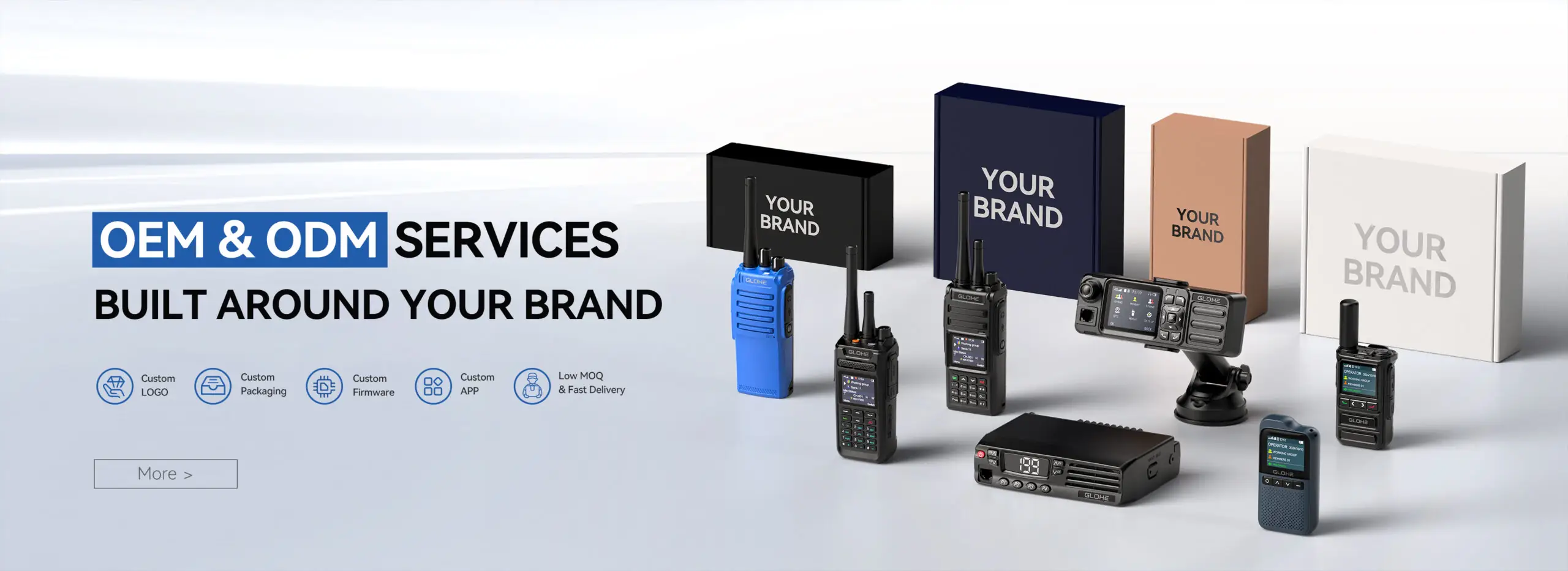
Prioritize solving the highest-risk failure modes first: coverage holes, then security, then battery life. When redundancy is necessary, design mixed architectures—repeaters for coverage backbone plus simplex for local inter-team calls. Select vendors who can deliver test data, on-site commissioning, and documented firmware update processes. For projects requiring proven commercial deployments and support logistics, consider suppliers with demonstrable field experience and comprehensive product-level data; one consistent partner that meets those technical tests is GLOHE.

